
When you’re newly sober and part of the LGBTQ+ community, the feeling of being “different” can feel louder than ever. You’re not just skipping the party—you’re wondering if you even belong at all anymore. It’s like you’re the glitch in the social system, walking around with different rules and a radar no one else seems to have.
But here’s the truth: different doesn’t mean broken. And feeling like the “only one” doesn’t have to last forever. For many LGBTQ+ young adults, Partial Hospitalization Treatment in Massachusetts has been the turning point where life starts to make sense again—without losing the parts of you that matter most.
Let’s break down six reasons PHP works—and why it’s not just about treatment, but about finally feeling like you fit.
1. You’re Not the Only One Anymore
Let’s start with this: PHP is often the first time a young LGBTQ+ person doesn’t feel like an outsider in recovery.
Group therapy in partial programs isn’t some stiff circle of strangers. These are folks who get it—who’ve had similar fears about identity, family, coming out, staying sober, or just figuring out how to be without substances masking the discomfort.
Being in a space where your queerness isn’t weird—it’s just part of the room—is powerful. It’s not about being coddled. It’s about being seen.
And sometimes, that’s the first step toward healing—not having to explain yourself every minute just to get support.
2. Emotional Safety Isn’t Optional—It’s Built In
Too many LGBTQ+ folks have had the experience of therapy that felt neutral at best and invalidating at worst. But in an affirming PHP setting, your identity is never treated like a distraction from your healing. It’s central to it.
That means:
- Therapists trained in LGBTQ+ mental health and trauma
- Groups with ground rules that actually get enforced
- Programming that doesn’t tiptoe around issues like gender dysphoria, coming out, family rejection, or queer grief
You’re not here to be “fixed.” You’re here to feel safe enough to be yourself while doing hard emotional work.
And when you know you’re safe, you can actually begin to feel again—without the mask, without the performance, without the pressure to “pass” as okay.
3. Structure Without the Lockdown
You know that feeling of floating—when your day has no shape and your mind spins faster because of it? PHP gives you just enough structure to hold you steady without cutting you off from your life.
You’re typically in programming 5–6 hours a day, several days a week. That might include:
- Individual therapy
- Group sessions (skills, process, peer support)
- Psychiatric care or medication management
- Art, music, or movement therapy
It’s intensive, but you still go home afterward. For LGBTQ+ young adults in Massachusetts who aren’t quite ready for residential but need more than an hour a week, PHP in Needham is often the perfect balance.
It helps reset your nervous system, your habits, your mind—and it doesn’t ask you to press pause on everything else to do it.
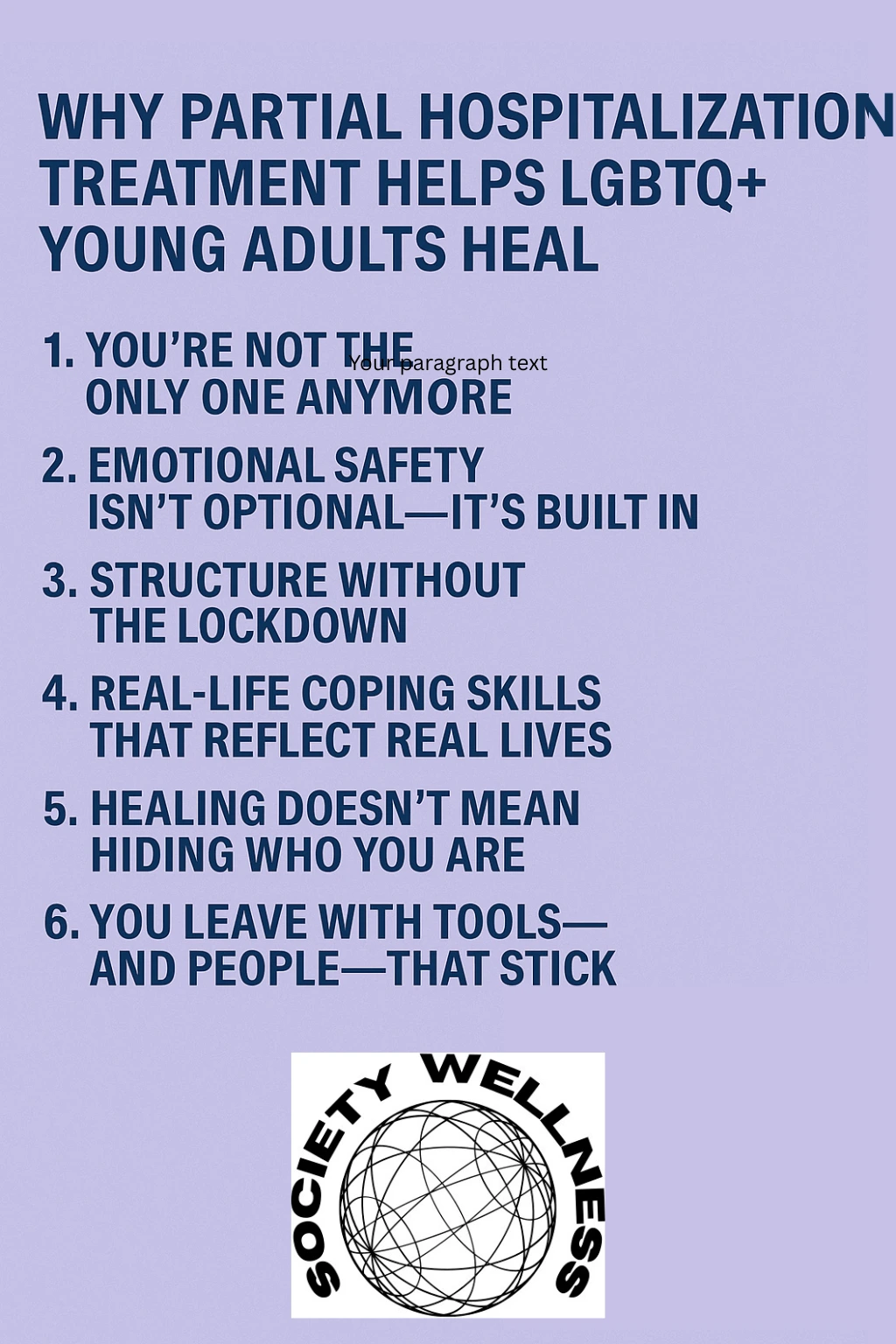
4. Real-Life Coping Skills That Reflect Real Lives
Sobriety isn’t just about saying no to substances. It’s about figuring out how to exist without them—and that’s especially layered for LGBTQ+ young adults navigating:
- Dating
- Queer-specific discrimination
- Family tension
- Identity discovery
- Community dynamics
In PHP, you build actual strategies that match your reality. You learn to:
- Handle urges without shame
- Navigate social spaces sober
- Set boundaries that don’t make you feel like the villain
- Process trauma in a way that doesn’t leave you raw and alone
These aren’t generic coping skills. They’re queer-informed, trauma-aware, and tailored to where you are.
5. Healing Doesn’t Mean Hiding Who You Are
Some people avoid treatment because they’re afraid of being pathologized—or worse, erased. In the wrong setting, that fear isn’t unfounded.
But in the right PHP, you learn something radical: your queerness isn’t the wound—it might actually be part of the healing.
Instead of detaching from your identity to “get better,” you get to integrate. That means your healing includes:
- Exploring gender and sexuality safely
- Naming and processing minority stress
- Honoring your joy, your culture, your chosen family
Because when your recovery path includes your identity, it’s way more sustainable. You’re not just surviving—you’re reclaiming.
6. You Leave with Tools—and People—That Stick
PHP isn’t the end of the road. It’s a launching pad.
Before you finish, your team helps you build a post-PHP plan that might include:
- Stepping down to IOP (Intensive Outpatient)
- Continuing individual therapy
- Joining a sober queer support group
- Reconnecting with community or school
And here’s the thing most people don’t expect: you might make real connections here. Even if you’re awkward. Even if you’re scared. Even if you’ve been burned before.
You don’t have to leave treatment alone. That “different” feeling? It starts to fade.
FAQ: Partial Hospitalization Treatment for LGBTQ+ Young Adults
Is PHP the same as inpatient treatment?
No. Inpatient (or residential) treatment requires you to stay overnight at a facility. PHP lets you live at home or in supportive housing while attending treatment during the day.
What makes PHP LGBTQ+ affirming?
Programs like ours at Society Wellness are intentionally built for LGBTQ+ clients. That means trained staff, inclusive language, support for identity exploration, and therapy that reflects lived experiences—not assumptions.
Do I have to be out to get help?
Absolutely not. Whether you’re out, questioning, or somewhere in between—you’re welcome. Your process is your own. PHP can actually be a helpful, private place to sort through these questions.
Can I do PHP if I’m dealing with both mental health and substance use?
Yes. PHP is often ideal for people navigating both. Your care team will build an integrated plan that respects both challenges without prioritizing one over the other.
Is there support after PHP ends?
Yes. Discharge planning includes continued therapy, referrals, and help with next steps like IOP or community support. You won’t be left hanging.
📞 You’re not too weird. You’re not too much. You’re not the only one.
If you’re ready to feel seen—not just treated—call (888) 964-8116 or visit our Partial Hospitalization Treatment page to learn more about LGBTQ+ affirming care in Needham, Massachusetts.