

You stopped showing up.
Maybe it was one missed group, then another. Maybe it was a bad week. Or a relapse. Or just a heavy, slow slide into “I’ll go tomorrow”—until tomorrow never came.
You might not even be sure why you left. Life got loud. You got tired. You didn’t want to talk about it.
That’s okay.
Here’s what matters: you’re thinking about coming back.
And that alone makes you brave.
At Society Wellness Behavioral Health, our intensive outpatient program isn’t just for people who never stumble. It’s built for people who take detours. Who disappear. Who relapse. Who ghost. Who come back.
You don’t need to explain yourself to be welcomed. But if you’re ready, here’s how to restart—without shame, without pretense, and without starting over from zero.
Step 1: Stop Trying to “Earn” Your Way Back
This is the trap most people fall into:
“I’ll come back once I’ve been sober for a week.”
“Let me get my life together first.”
“I need to clean up before I face anyone.”
But let’s be honest—if you could fix it on your own, you wouldn’t need the program.
You don’t have to “earn” your spot.
You already belong—mess, relapse, and all.
Restarting an intensive outpatient program means starting where you are. Not where you think you “should” be. Not after you detox in silence. Not after you’ve patched up your mistakes.
Right now is enough.
Step 2: Reach Out (Even if It’s Just a One-Liner)
You don’t need to craft an apology email or explain your absence in a paragraph.
You can text. Call. DM. Email.
You can say:
- “Hey, I want to come back. Can we talk?”
- “I know I ghosted. I need help.”
- “Is it okay to rejoin?”
We’ll say yes.
The first step is making contact—even if your voice shakes, even if your heart’s pounding. We’ve seen this moment before. And we know how much courage it takes.
You’re not weak for returning. You’re strong for not disappearing forever.
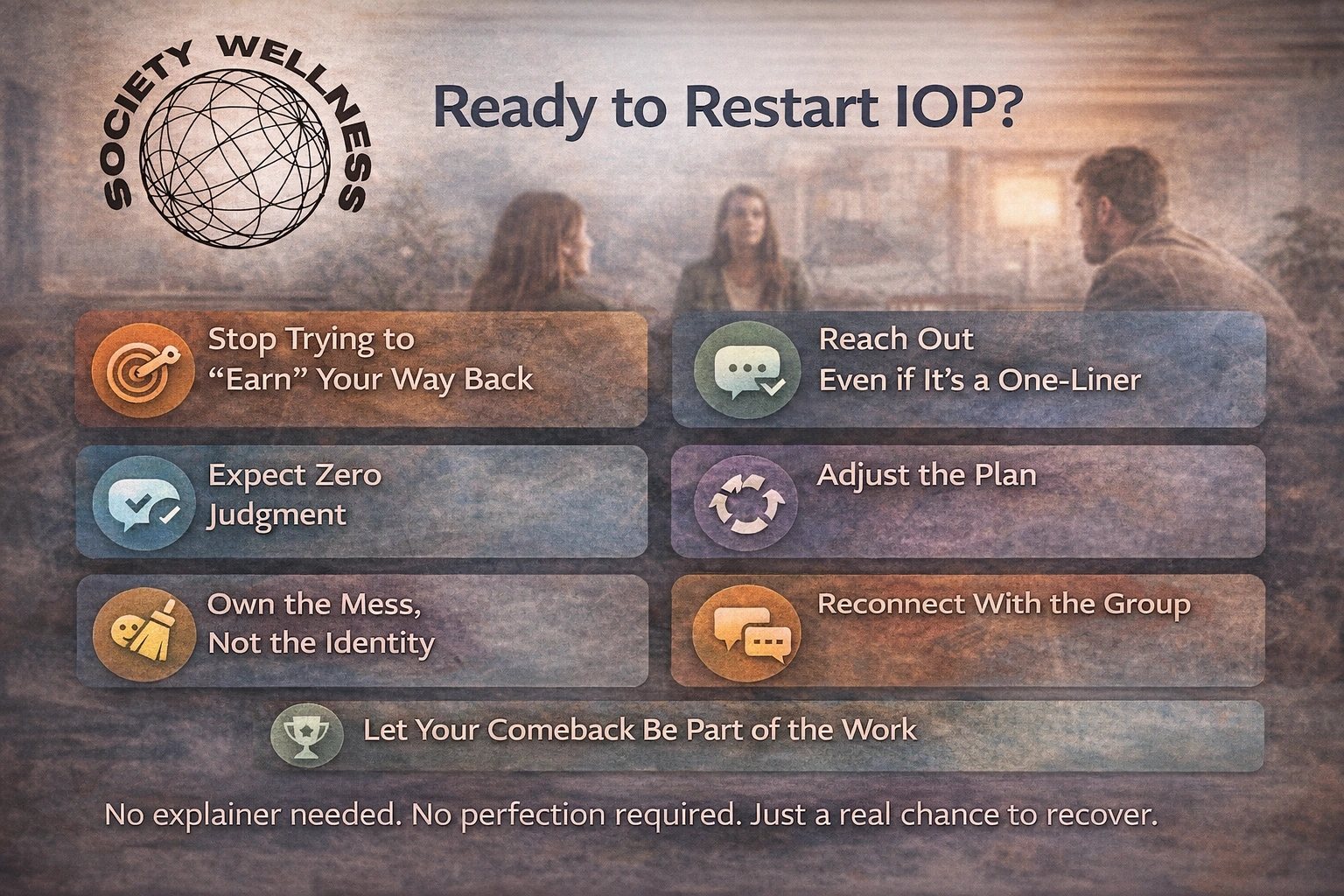
Step 3: Expect Zero Judgment
This isn’t a courtroom. It’s not a performance review. You’re not being evaluated.
In our program, relapse isn’t failure—it’s information.
Disappearance isn’t shameful—it’s a signal.
Whatever pulled you away—substance, burnout, fear, life chaos—we’re not here to punish it. We’re here to understand it.
So when you reenter, we’ll ask:
- What happened?
- What did you learn?
- What do you need now?
Not to interrogate you—but to support you better.
Step 4: Adjust the Plan—This Isn’t Copy-Paste Recovery
Your needs may be different now than when you first enrolled in IOP.
Your relapse may have exposed some gaps. Or maybe the old format didn’t feel right. That’s normal.
Restarting doesn’t mean repeating.
When you rejoin, we’ll revisit:
- Your schedule: Do you need different group times?
- Your focus: Is substance use still central, or are mental health patterns more present?
- Your pace: Do you want to ease in slowly or go deep right away?
- Your support: Is 1:1 work feeling more essential now?
Recovery isn’t a loop. It’s a spiral. You’re not back at square one—you’re further along, with more insight than before.
Step 5: Own the Mess Without Making It Your Identity
A lot of people come back to IOP thinking they have to wear their relapse like a name tag.
You don’t.
You can be honest without self-shaming. You can say:
- “I used again.”
- “I disappeared.”
- “I was overwhelmed.”
And then move forward.
Relapse is not your defining feature. It’s one part of your story—and now, you’re writing the next part.
Let the past inform you, not imprison you.
Step 6: Reconnect With the Group (Even if It Feels Weird)
Coming back to a group you left can feel awkward. You might worry what others will think. You might feel like “the one who failed.”
Let’s be real: nobody’s thinking that.
Most of them are thinking, “I’m glad they came back.”
Because almost everyone in the room has felt the urge to ghost. You just acted on it.
And guess what? Now you get to model what returning looks like.
That’s not weak. That’s powerful.
Step 7: Let Your Comeback Be Part of the Work
You didn’t just fall off the wagon. You learned something about what knocks you off it.
That insight? It’s part of your recovery.
Use group to explore:
- What triggered your exit
- What supports were missing
- What shame you carried while away
- What brought you back
There’s gold in that story. Not just for you—but for the people still in their own detours.
Your comeback can help someone else make theirs.
Real Client Story: “I Was So Ashamed. And Then I Was Home.”
“I skipped one group. Then two. Then I stopped answering calls. I was drinking again, spiraling. But the thought that wouldn’t leave me was, ‘I wish I could go back.’ I finally texted, ‘Can I rejoin?’ The answer was yes. Not ‘Where were you?’ Not ‘Why’d you screw up?’ Just yes. That’s when I knew this place was different.”
– IOP Client, 2023
You’re not the first to leave.
But you might be the next to return—and finally stay.
What Our Intensive Outpatient Program Offers
At Society Wellness, our IOP is built with returners in mind.
We believe in open doors, not closed chapters.
Our program includes:
- 3–5 days a week of structured therapy and skill-building
- Individual counseling to process relapse and reconnection
- Group support that normalizes disappearing and returning
- Flexible scheduling, including virtual options
- LGBTQ+ affirming care, no questions asked
We don’t expect perfection. We expect real humans—with real stories, stumbles, and restarts.
Explore our intensive outpatient program here. Whether this is your first try or your fifth, you still belong.
FAQs About Restarting IOP After a Relapse or Dropout
Will I be punished for leaving or using?
No. This is a judgment-free space. We’ll welcome you back and help you process what happened—but there are no punishments.
Do I have to reapply?
Nope. We’ll do a brief reassessment to make sure we match you with the right group or support level—but it’s not a full restart.
Can I change my schedule when I come back?
Yes. Many clients adjust their days, times, or virtual options when they return. We’ll help make it work for you.
What if I’m embarrassed?
You wouldn’t be human if you weren’t. But we promise—most people feel relief within 10 minutes of being back. You’ll remember why you came in the first place.
I relapsed badly. Is IOP still the right level of care?
It might be. But if you need detox or inpatient first, we’ll help you access that too. The goal is safety, not pushing you into a program that doesn’t fit.
This Isn’t a Do-Over. It’s a Reentry.
You’re not redoing the work. You’re deepening it.
You’re not back at the beginning. You’re picking up the thread.
Returning to an intensive outpatient program after a break is an act of power—not penance. It says: “I’m not done yet.”
And we’ll be right here when you walk through the door again.
Ready to come back? The door’s still open.
Call (888) 964-8116 to learn more about our intensive outpatient program services Boston, MA.