

You did everything right. You supported them through treatment. You listened, hoped, helped, held space.
And now they’re drinking again.
Maybe it started quietly—missed calls, strange excuses, shifts in mood. Maybe it came all at once. However it returned, the ache is familiar: the tightness in your chest, the question in your gut, the fear that whispers, “Are we doing this again?”
If your young adult child has returned to drinking after treatment, you’re not alone. And you’re not powerless. At Society Wellness Behavioral Health in Needham, Massachusetts, we support families walking through this exact season. Here’s what alcohol addiction treatment can look like the second (or third) time—and how to support your child without losing yourself in the process.
Relapse Is Painful—But It’s Not the End
Let’s say this clearly: relapse does not mean everything is lost.
It can feel like a betrayal. It can feel like grief. And in many ways, it is both. But it is also something else: a part of recovery that happens to many, even those who were doing well.
What it doesn’t mean:
- That treatment “didn’t work”
- That your child doesn’t care
- That you failed as a parent
Relapse doesn’t erase the progress they made. And it doesn’t mean they’re back at square one. But it does mean they may need different kinds of support than before.
Why Relapse Happens—Even After Good Treatment
Many young adults leave treatment feeling empowered—but not fully equipped. Life hits hard after discharge: social pressure, unstructured time, relationships, unresolved trauma, untreated depression or anxiety.
And alcohol is accessible. Familiar. Accepted in almost every social space.
Without continued support, even well-intentioned sobriety can start to unravel.
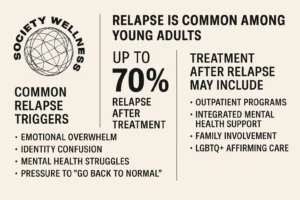
Common relapse triggers include:
- Emotional overwhelm without coping tools
- Loneliness or identity confusion
- Mental health struggles that were under-addressed
- Pressure to “go back to normal” too quickly
- Shame over struggling again
Relapse is not about weakness. It’s about unmet needs—and unmet needs can be addressed.
How Alcohol Addiction Treatment Can Help After Relapse
When someone returns to drinking, it’s not always about doing the same treatment again. It’s about doing the right treatment now.
At Society Wellness, we approach relapse-informed care with:
- Reassessment, not judgment – We ask what’s changed. What’s hurting. What’s needed now.
- Customized plans – Not every return requires inpatient care. Many benefit from outpatient or intensive outpatient (IOP) programs that balance treatment with life.
- Mental health integration – Depression, trauma, or ADHD often drive drinking. We address those head-on.
- Family involvement – You get support, too. Whether through communication coaching or dedicated family sessions, you’re not sidelined.
- LGBTQ+ affirming care – Many of our clients are navigating complex identity questions. Our space is safe, inclusive, and affirming without exception.
Relapse doesn’t mean doing more of the same. It means doing something better matched to who they are now.
Your Role as a Parent: Support With Boundaries
It’s tempting to jump back into rescue mode. Book the appointment. Clean up the mess. Beg, plead, fix.
But part of your role—especially now—is to create steady ground without absorbing their chaos.
This might look like:
- Saying, “I love you, and I’m scared too. Let’s talk when you’re ready.”
- Setting boundaries like no substance use in your home, or not covering certain costs until treatment is re-engaged
- Letting them feel the discomfort of their choices—without cutting off connection
- Seeking support for yourself (support groups, therapy, even just a space to vent)
You can offer safety without enabling. Love without rescuing. Openness without over-functioning.
What to Expect When Reentering Treatment
The first call is often the hardest—but it can also be the beginning of something more grounded.
Here’s what reengaging in alcohol addiction treatment might involve at Society Wellness:
- Clinical Intake
A no-pressure conversation to explore what’s been happening. We talk with the young adult—not just about them. - Treatment Planning
We design a plan with their input that fits their current needs—considering school, work, emotional bandwidth, and more. - Therapy + Group Support
Individual therapy is paired with peer-based groups, focused on real-life challenges like relationships, anxiety, and relapse prevention. - Family Touchpoints
You’ll be invited (with their consent) into specific conversations about how to support recovery without losing yourself. - Flexible Scheduling
Our outpatient and IOP models are designed to meet people where they are—not force unrealistic structure on someone rebuilding.
This isn’t about doing it “right” this time. It’s about doing it together—with support.
You’re Not Alone—Even If It Feels Like You Are
One of the cruelest parts of watching a child relapse is the silence.
You look around and it feels like everyone else’s kids are thriving. Posting graduation pics. Starting jobs. Smiling at family dinners.
But behind closed doors, many families are carrying this same heartbreak.
You are not alone.
And at Society Wellness, we don’t just support your child—we support you. We understand that when someone in the family struggles, the whole family feels it. You deserve care too.
FAQs for Parents of Relapsing Young Adults
Is it my fault they started drinking again?
No. Relapse is rarely about one moment or mistake. It’s a complex mix of stress, biology, mental health, and life context. Blame isn’t helpful—but support is.
Should I force them back into treatment?
You can’t force recovery—but you can invite it. Express your concern clearly. Set loving boundaries. Offer information. Stay available without fixing.
What if they say they don’t need help?
Denial is common—especially in young adults. A non-punitive, supportive approach often works better than ultimatums. Clinician-led conversations can help shift resistance.
Is outpatient treatment enough?
Often, yes. Many relapsing young adults benefit from outpatient or IOP models that allow them to stay engaged with work, school, or daily life while receiving structured care.
What if this happens again?
Recovery is a long process. Progress isn’t always linear. But every step—every return—teaches something. Support systems can be rebuilt again and again.
Hope Isn’t Naive—It’s Necessary
Your child may not be ready today. But they called once. They reached out before. That spark is still there.
Sometimes hope looks like starting over. Other times, it looks like waiting well. Holding space. Staying rooted while they find their way back.
At Society Wellness, we believe recovery is always possible—no matter how many times someone returns to it.
You don’t have to hold this alone.
Call (888) 964-8116 or visit Society Wellness Behavioral Health’s Alcohol Addiction Treatment in Needham, Massachusetts. Whether you’re ready to act or just need a place to talk, we’re here—for them, and for you.