

I used to say it automatically.
“I’d get help, but I just don’t have the time.”
It sounded mature. Responsible. Successful, even.
But if I’m honest? It was the last defense between me and admitting something wasn’t right.
And that almost kept me from an intensive outpatient program in Massachusetts.
I Was High-Functioning — and Quietly Falling Apart
I wasn’t missing deadlines.
I wasn’t getting DUIs.
I wasn’t “that person.”
I was the dependable one. The one people trusted. The one who could juggle ten things and still smile at dinner.
But every night, when the house got quiet, I drank like I was trying to erase the day. Sometimes more than I planned. Sometimes way more.
Every morning, I’d wake up with that familiar mix of shame and determination.
Okay. Not tonight. I’ve got this.
By 5 p.m., the mental negotiation would start again.
I didn’t look like I needed help.
That’s what made it so easy to avoid it.
“Too Busy” Was Code for “Too Scared”
Here’s what being “too busy” really meant for me:
- I was scared people would find out.
- I was scared treatment would label me.
- I was scared I wouldn’t be able to keep up.
- I was scared it wouldn’t work — and then what?
So instead of saying, “I’m afraid,” I said, “I’m slammed.”
It felt safer.
When someone first mentioned multi-day weekly treatment, my brain immediately went to worst-case scenarios.
How would I explain the time away?
What if my boss asks questions?
What if this becomes my whole identity?
But I never questioned the hours I was already spending drinking, recovering, hiding, recalculating.
I was already structuring my life around alcohol.
I just didn’t call it that.
The Mental Load Was Crushing Me
No one talks about the mental gymnastics of being high-functioning and struggling.
It’s constant background noise:
- Did I say anything weird last night?
- Do I smell like it?
- Can I get through this meeting without shaking?
- Am I drinking more than everyone else?
- If I skip tonight, will I even be able to sleep?
It’s like running a secret second job — unpaid, invisible, relentless.
I wasn’t out of control.
But I wasn’t free either.
And the effort to look fine was exhausting.
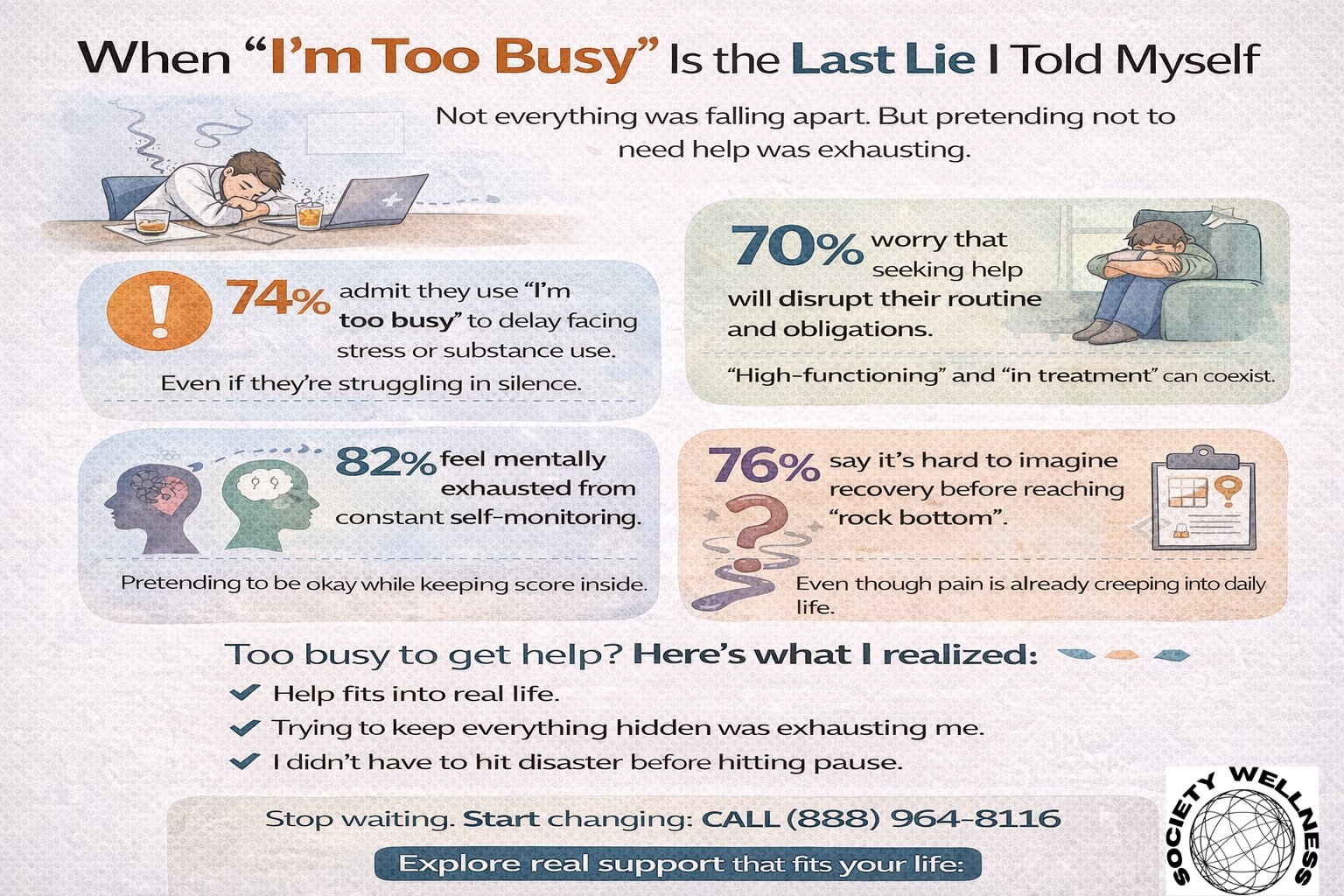
I Didn’t Want to Be “That Person”
I had a very specific image in my head of who goes to treatment.
Rock bottom. Chaos. Lost everything.
That wasn’t me.
I still had everything — technically.
But here’s what I’ve learned:
You don’t have to lose everything to admit something is costing you too much.
I hadn’t crashed my life.
But I was driving it with one hand on the wheel and one hand hiding a bottle.
When I finally started reading about structured outpatient care, I expected to feel panic.
Instead, I felt something else.
Relief.
The Moment I Knew Avoiding It Was Harder Than Trying
The real turning point wasn’t dramatic.
It was a Tuesday.
I had back-to-back meetings. I was sharp. Productive. Even complimented on a presentation.
And I still went home and drank alone.
That’s when it hit me: external success wasn’t touching the internal ache.
Being busy wasn’t solving anything. It was just delaying the reckoning.
I realized something uncomfortable:
If I kept waiting until I had “more time,” I would never go.
There will always be another deadline. Another project. Another excuse.
What Actually Happened When I Started
I expected chaos.
Instead, I found structure.
I expected shame.
Instead, I found people who sounded exactly like me.
Professionals. Parents. People with graduate degrees and carpool schedules and LinkedIn profiles.
No one looked like the stereotype I’d been hiding from.
The schedule was intentional. Supportive. Built for people who still had lives — because most of us do.
And slowly, something shifted.
I wasn’t white-knuckling evenings anymore.
I wasn’t negotiating with myself at 2 p.m.
I wasn’t running that secret operating system in my head 24/7.
I was tired — but it was a clean kind of tired. The kind that comes from doing real work, not hiding.
The Myth of “Now’s Not a Good Time”
If you’re high-functioning, you will always be able to justify waiting.
- After this quarter.
- After the holidays.
- After this launch.
- After the kids are older.
- After things calm down.
But here’s the truth:
Things don’t calm down.
You just get more used to carrying too much.
The longer I waited, the more normal my exhaustion felt.
And that’s dangerous.
Because you can survive like that for years.
But you don’t get to thrive.
FAQ: What High-Functioning People Secretly Worry About
What if I don’t think I’m “bad enough”?
You don’t have to be falling apart publicly to deserve help. If you’re constantly thinking about your drinking or substance use, negotiating with yourself, hiding it, or feeling drained by it — that’s enough. Pain doesn’t have to be dramatic to be real.
Can I keep working while getting support?
Yes. That was one of my biggest fears. Many structured outpatient options are designed for people who are still working, parenting, or managing daily responsibilities.
It’s not about removing you from your life. It’s about helping you show up to it more honestly.
What if people find out?
Most people won’t — unless you choose to tell them. Privacy is taken seriously. And you get to decide who knows your story. Also, here’s something I didn’t expect: the shame shrinks when you stop hiding from yourself.
What if it doesn’t work?
That fear is real. But doing nothing was already not working. Support isn’t magic. It’s participation. It’s honesty. It’s willingness. And if one approach isn’t the right fit, that doesn’t mean you’re broken. It means you adjust.
Will I lose who I am?
I was terrified sobriety would make me dull. Flat. Less creative. Less social. The opposite happened. I didn’t lose myself. I lost the constant anxiety that I might lose control. There’s a difference.
How do I know it’s time?
If you’re reading this and seeing yourself in it? That’s usually a sign. You don’t have to wait for disaster. Sometimes “tired of being tired” is enough.
If You’re Still Saying You’re Too Busy
Let me be direct with you. You are not too busy.
You are carrying more than you’re letting anyone see.
There’s a version of you that doesn’t have to rehearse conversations, calculate drinks, or wake up with dread. And you don’t have to burn your life down to access that version.
If you’ve been quietly wondering whether an Intensive outpatient program could fit into your life without blowing it up, it might be time to look at it honestly.
You can explore Society Wellness Behavioral Health’s approach to care through their intensive outpatient program in Massachusetts and see what structured support actually looks like.
You don’t have to decide everything today. Just stop telling yourself you’re too busy.
Call (888) 964-8116 or visit our Intensive outpatient program services in Massachusetts to learn more about our Intensive outpatient program services in Massachusetts.