

There’s a specific kind of silence that settles over a house when something isn’t right.
You hear your child’s voice change. You notice the shorter texts. The late nights. The old defensiveness creeping back in.
And then you find out they’re using again.
If you’re the parent of a 20-year-old who’s relapsed, you may be carrying grief that doesn’t have a name. You might be replaying every conversation in your head. Wondering what you missed. Wondering if the arguments at home pushed them further away.
Let’s say this gently:
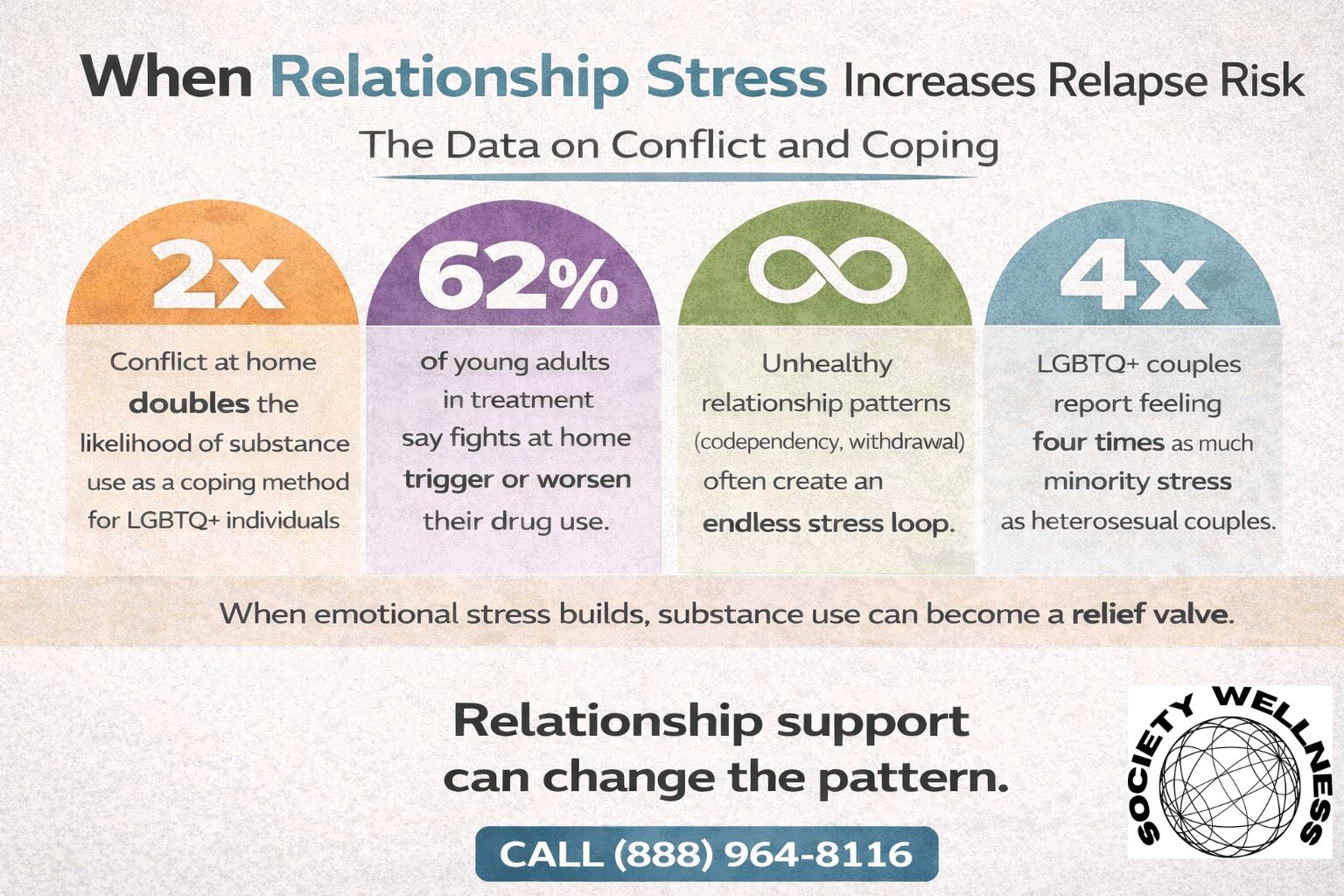
Conflict at home doesn’t cause addiction.
But unresolved relationship stress can absolutely make it harder for someone to stay steady—especially when identity, stigma, and emotional safety are part of the picture.
And sometimes, when tension inside a relationship keeps rising, substances become the relief valve.
When Conflict Becomes a Trigger, Not Just a Disagreement
All couples argue. That’s normal.
But there’s a difference between disagreement and chronic emotional strain.
When two people are stuck in reactive cycles—shutting down, exploding, withdrawing, criticizing—the nervous system stays on high alert. And for a young adult already managing anxiety, trauma history, or identity stress, that constant activation can feel unbearable.
Substances can temporarily numb that intensity.
Not because your child doesn’t care.
Not because they’re choosing chaos.
But because they’re overwhelmed.
For LGBTQ+ couples, there are often additional layers:
- Fear of rejection from family or community
- Internalized shame
- Pressure to “prove” the relationship is stable
- Past experiences of discrimination or bullying
- Religious or cultural conflict
If those pressures aren’t named and processed, they don’t disappear. They build.
And when emotional temperature rises, relapse risk rises with it.
The Pattern Most Families Don’t See
Parents often see the surface:
- “They fight constantly.”
- “Their partner is dramatic.”
- “My child is different when they’re with them.”
But underneath those observations is usually a repeating loop.
It might look like this:
- One partner feels insecure and reaches out intensely.
- The other feels overwhelmed and pulls away.
- The first partner escalates.
- The second shuts down further.
- Substances enter as a coping tool.
Then guilt sets in.
Then promises are made.
Then tension slowly returns.
It’s not a character flaw. It’s a pattern.
And patterns can be interrupted.
Why Relationship-Focused Support Can Change the Dynamic
When couples enter structured, affirming support together, they’re not being told, “You’re the problem.”
They’re being given tools.
In Lgbtq+ couples counseling, the focus isn’t just on communication skills in a generic sense. It includes understanding:
- Minority stress and its impact on attachment
- How identity wounds show up during conflict
- How substance use may function as emotional regulation
- How to build safety in moments of disagreement
When couples learn to regulate conflict instead of react to it, something powerful happens: the home stops feeling like a threat.
And when the nervous system feels safer, the urge to numb often decreases.
A Realistic Success Story
I’ve seen this more times than I can count.
A 22-year-old relapses after six months sober. Their partner feels betrayed and panicked. The parents are furious at first—then terrified.
Everyone is talking. No one is hearing each other.
The couple agrees—reluctantly—to try relationship support. The first few sessions are tense. Defensive. Tearful.
But then something shifts.
Instead of arguing about the relapse, they start talking about what happened the week before it. A fight about trust. A comment that hit deeper than expected. An old fear of abandonment resurfacing.
They learn how to slow down conversations instead of escalating them. They practice naming feelings before they explode.
Relapse doesn’t vanish overnight. But the intensity around it softens.
And that space—less chaos, more understanding—creates room for healing.
Not perfect. Just better.
What This Means for You as a Parent
You are not responsible for fixing their relationship.
You are not responsible for making them choose help.
But you can shift how you respond.
Here are a few gentle pivots that can lower tension instead of increasing it:
1. Avoid turning the partner into the villain.
Even if you’re worried. Even if you’re frustrated. Framing the partner as “the problem” usually pushes your child closer to them, not toward you.
2. Stay curious instead of accusatory.
Instead of: “Are they making you use again?”
Try: “It seems like things have felt really intense lately. What’s that been like for you?”
3. Separate identity from behavior.
Support their relationship identity without endorsing harmful behaviors. You can say, “I respect who you love. I’m worried about the stress I see affecting you.”
4. Take care of your own nervous system.
When parents are constantly in panic mode, it amplifies the household tension. Therapy, support groups, or simply regulated conversations can change the tone of the home.
Love doesn’t mean absorbing chaos.
It means staying steady when things feel unsteady.
When to Consider Bringing in Relationship Support
You might explore this option if:
- Arguments frequently escalate and feel unresolved
- Substance use tends to follow conflict
- One or both partners feel chronically misunderstood
- There’s history of trauma impacting attachment
- You notice your child feels constantly “on edge” in the relationship
Relationship work doesn’t replace individual recovery support. It complements it.
It addresses the environment around the behavior—not just the behavior itself.
If you want to better understand how affirming, structured support works in this space, you can learn more about our approach to relationship-focused care for couples.
The Hard Truth and the Hope
Here’s the hard truth: you can’t control relapse.
Here’s the hopeful truth: relapse does not mean the story is over.
Sometimes relapse is a signal—not of failure—but of unmet needs. Unresolved pain. Or relational stress that hasn’t been addressed yet.
Think of it like a smoke alarm. You can keep silencing it. Or you can look for what’s smoldering.
Relationship support helps identify the smoldering parts before they become full fires.
And for many couples, especially those navigating identity-related stress, having a space that fully affirms who they are changes everything.
Frequently Asked Questions
Is conflict really enough to cause someone to relapse?
Conflict alone doesn’t “cause” relapse. Addiction and substance use are complex.
But chronic emotional stress, especially within intimate relationships, can increase vulnerability. If someone uses substances to regulate overwhelming feelings, repeated conflict can act as a trigger.
Reducing relational stress often lowers relapse risk.
What if I don’t like my child’s partner?
That’s more common than most parents admit.
The key question isn’t whether you like them. It’s whether the relationship dynamics are healthy and whether your child feels safe.
If you approach from criticism, your child may withdraw. If you approach from concern and curiosity, you’re more likely to stay connected.
Relationship support can help clarify whether the issue is compatibility, stress, or deeper dysfunction.
Will relationship counseling blame my child?
Healthy counseling doesn’t blame. It identifies patterns.
The focus is on how both partners contribute to cycles—not to assign fault, but to create change.
It also looks at how substance use interacts with emotional regulation, attachment styles, and identity stress.
What if only one partner wants help?
That happens often.
If your child is open to individual support while encouraging their partner to join later, that’s still progress. Change in one partner can shift the dynamic.
Over time, the other partner may become more open when they see the difference.
Is this appropriate if my child is still actively using?
Yes—with nuance.
If substance use is severe or medically risky, stabilization may need to come first. But relationship work can happen alongside recovery support.
In many cases, addressing the relational triggers early prevents further escalation.
How do I bring this up without making things worse?
Lead with care.
Try something like:
“I love you. I see how much stress you’ve both been under. I wonder if having support together might take some pressure off.”
Offer, don’t demand.
Sometimes planting the seed is enough.
What if they refuse everything?
That’s one of the hardest places to stand.
If your child refuses support, focus on what you can control—your boundaries, your responses, your self-care.
You can’t force change. But you can stop participating in unhealthy patterns.
And often, when parents change their approach, it opens space for the young adult to reconsider theirs.
You Are Not Alone in This
If your home feels like a battlefield right now, it doesn’t mean your family is broken.
It means there’s pain that hasn’t been fully tended to yet.
Relapse hurts. Conflict exhausts everyone. But with the right support, relationships can become part of the healing—not the harm.
Call (888) 964-8116 or visit our Lgbtq+ couples counseling services in Massachusetts to learn more.
You didn’t fail. You’re a parent doing the bravest thing possible—still showing up. And there are still options forward.