

You’re not missing deadlines.
You’re not getting written up.
You’re not the “mess” people picture when they think about addiction.
You’re just… tired.
Tired of calculating how much is too much.
Tired of promising yourself “not tonight” and breaking it.
Tired of wondering how long you can keep this pace before something cracks.
At Society Wellness Behavioral Health, we work with professionals who are still showing up at work—but barely showing up for themselves. If you’ve found yourself reading about our intensive outpatient program in Massachusetts between meetings, you’re not dramatic.
You’re paying attention.
And that matters.
You Don’t Have to Disappear to Get Better
One of the biggest barriers for high-functioning adults is this:
“If I get help, I’ll have to step away from everything.”
That fear keeps people stuck for years.
You’ve built a career. A reputation. Maybe a business. People rely on you. Walking away for a month—or more—can feel impossible.
The truth? Not everyone needs to press pause on their entire life to begin recovery.
Multi-day weekly treatment allows you to stay engaged in work and home life while doing real, meaningful therapeutic work. You don’t vanish. You adjust.
And that adjustment is often far less dramatic than your mind is telling you.
Your Schedule Doesn’t Have to Collapse
You already manage complex calendars. You coordinate teams, projects, deadlines.
Recovery doesn’t require chaos. It requires structure.
Our clients often:
- Attend sessions several days per week during set blocks
- Keep predictable routines
- Maintain employment while receiving consistent care
- Plan ahead for important work obligations
You treat quarterly reviews as non-negotiable.
This becomes non-negotiable too.
And here’s the part no one says out loud: high-functioning professionals often thrive in structured treatment settings because you understand commitment. You know how to show up. You just need the right container.
You’re Not “Too Successful” to Be Struggling
Addiction doesn’t only live in obvious places.
It lives in:
- The executive who drinks alone after client dinners
- The healthcare provider who numbs after 12-hour shifts
- The entrepreneur who uses to manage pressure
- The parent who waits until everyone’s asleep
High-functioning doesn’t mean unaffected. It means you’ve compensated well.
But compensation has a cost.
Sleep disruption. Irritability. Emotional distance. Subtle erosion of self-trust.
You might not be crashing.
But you might be slowly draining.
And slow drains are easy to ignore—until they’re not.
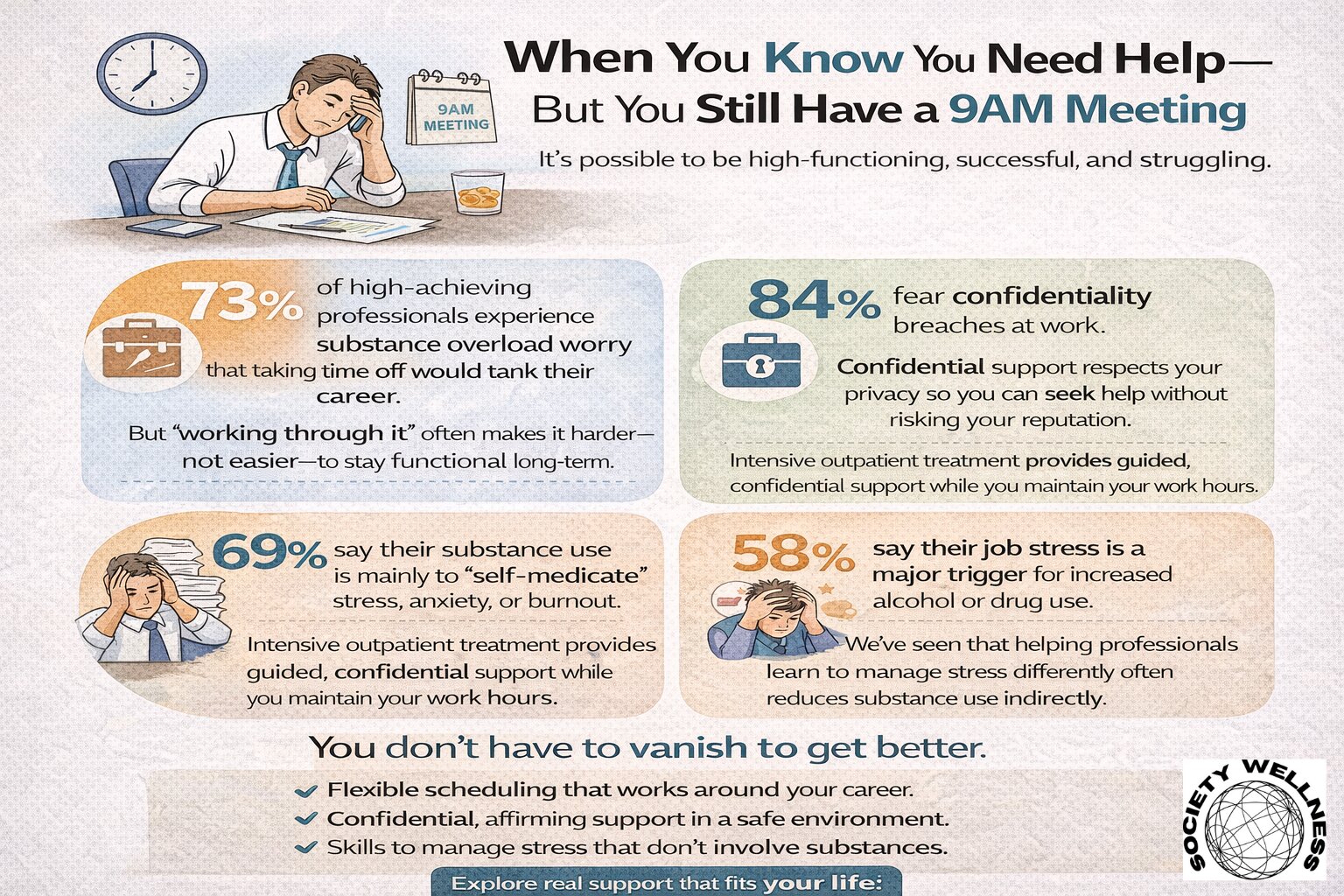
It’s Not About Labels. It’s About Impact.
Maybe you don’t identify with the word “addict.” Maybe that word feels heavy, exaggerated, not quite right.
We’re not here to force language onto you.
We’re here to ask better questions:
- Are you thinking about using before the workday ends?
- Have you tried to cut back and found it harder than expected?
- Are you managing anxiety, shame, or secrecy around your use?
- Are you afraid of what would happen if someone saw behind the curtain?
You don’t need to hit a cinematic rock bottom to justify getting help.
If your current relationship with substances is costing you energy, clarity, or peace—that’s enough.
What Actually Happens in Treatment When You’re Still Working
Let’s be clear: this isn’t a passive support group where you vent and go home unchanged.
You’ll engage in:
- Structured group therapy
- Individual sessions
- Skills-building around triggers, stress, and boundaries
- Honest conversations about pressure and performance
- Relapse prevention planning that fits your real life
You’ll examine not just your substance use—but the role it plays.
For many high-functioning adults, substances serve a purpose:
- Taking the edge off anxiety
- Transitioning from high-alert mode to “relaxed”
- Softening social performance pressure
- Managing burnout
We don’t pretend those functions don’t exist.
We help you build healthier replacements.
Because white-knuckling your way through the week isn’t recovery. It’s just another performance.
The Hidden Exhaustion of Being “Fine”
There’s a specific kind of fatigue that comes from being competent in public and unraveling in private.
You answer emails with precision.
Then lie awake at 2 a.m. replaying conversations.
You lead meetings confidently.
Then question yourself later.
You promise moderation.
Then overdo it again.
It’s not dramatic. It’s not loud.
It’s just relentless.
One client once described it as “carrying two versions of myself everywhere.”
That split is heavy.
Treatment isn’t about changing who you are.
It’s about integrating the parts you’ve been keeping separate.
You Don’t Have to Perform Here
In your career, you’re rewarded for composure.
Here, you’re rewarded for honesty.
You can say:
- “I don’t know if I’m ready to stop.”
- “I’m scared I won’t be as sharp.”
- “I use because I don’t know how to turn off my brain.”
You won’t be shamed. You won’t be compared to someone who’s lost everything.
We understand high-functioning substance use doesn’t look like chaos. It looks like control—until the control starts slipping.
And it’s far easier to intervene before a crisis than after one.
What Changes (And What Doesn’t)
You won’t lose:
- Your intelligence
- Your ambition
- Your leadership
- Your creativity
You may lose:
- The nightly negotiation
- The shame spiral
- The morning-after anxiety
- The mental math
Clarity often returns faster than people expect.
Sleep improves.
Reactivity decreases.
Decision-making sharpens.
Not because you’re “fixed.”
But because you’re no longer dividing your energy between living and hiding.
If You’re Waiting for It to Get Worse
A lot of high-achieving adults tell themselves:
“I’ll deal with it if it actually becomes a problem.”
But what if the fact that you’re researching options already means it is?
You don’t need a DUI.
You don’t need a public mistake.
You don’t need an intervention.
You’re allowed to intervene in your own life quietly.
At Society Wellness Behavioral Health, our intensive outpatient program supports working professionals who need meaningful care without abandoning their responsibilities. You can explore the structure and expectations in more detail on our core program page.
You built your career with intention.
You can approach recovery the same way.
Frequently Asked Questions
Can I really keep working while attending treatment?
Yes. Many of our clients maintain full-time employment. Schedules are structured to allow you to attend multiple sessions per week while still meeting professional obligations. Planning and communication (when appropriate) are part of the process.
Will my employer find out?
Treatment is confidential. We do not notify employers. Some clients choose to use sick leave or flexible scheduling; others attend outside traditional work hours. Disclosure is your decision.
What if I’m not sure I’m “bad enough” to need this?
If you’re questioning your relationship with substances, that’s worth exploring. You don’t need a diagnosis or dramatic consequences to benefit from structured support.
High-functioning does not equal unaffected.
What happens if I slip while in the program?
Slips are addressed directly and therapeutically—not punitively. The focus is understanding what happened, strengthening coping strategies, and adjusting your support plan.
Shame shuts people down. Insight moves people forward.
Is this just group therapy?
Group work is central, but it’s not the only component. You’ll also engage in individual sessions and skill-based interventions tailored to your stress patterns, triggers, and goals.
How long does it last?
Length varies depending on clinical need and progress. Many clients participate for several weeks to a few months. The goal is stabilization, insight, and sustainable skill-building—not indefinite attendance.
I’m scared sobriety will change who I am. Is that normal?
Completely. Many high-performing individuals worry they’ll lose their edge, creativity, or social ease. In reality, most discover those qualities were theirs all along—just clouded by stress and substance reliance.
You don’t have to implode to justify getting support.
You don’t have to confess everything to everyone.
You don’t have to wait for something irreversible.
If you’re reading this in between meetings, that’s not coincidence. It’s awareness.
Call (888) 964-8116 or visit our Intensive outpatient program services in Massachusetts to learn more about our Intensive outpatient program services in Massachusetts.