

You stopped going.
Maybe you meant to text your therapist back.
Maybe you told yourself you’d return next week.
Maybe you relapsed and felt too embarrassed to walk through the door again.
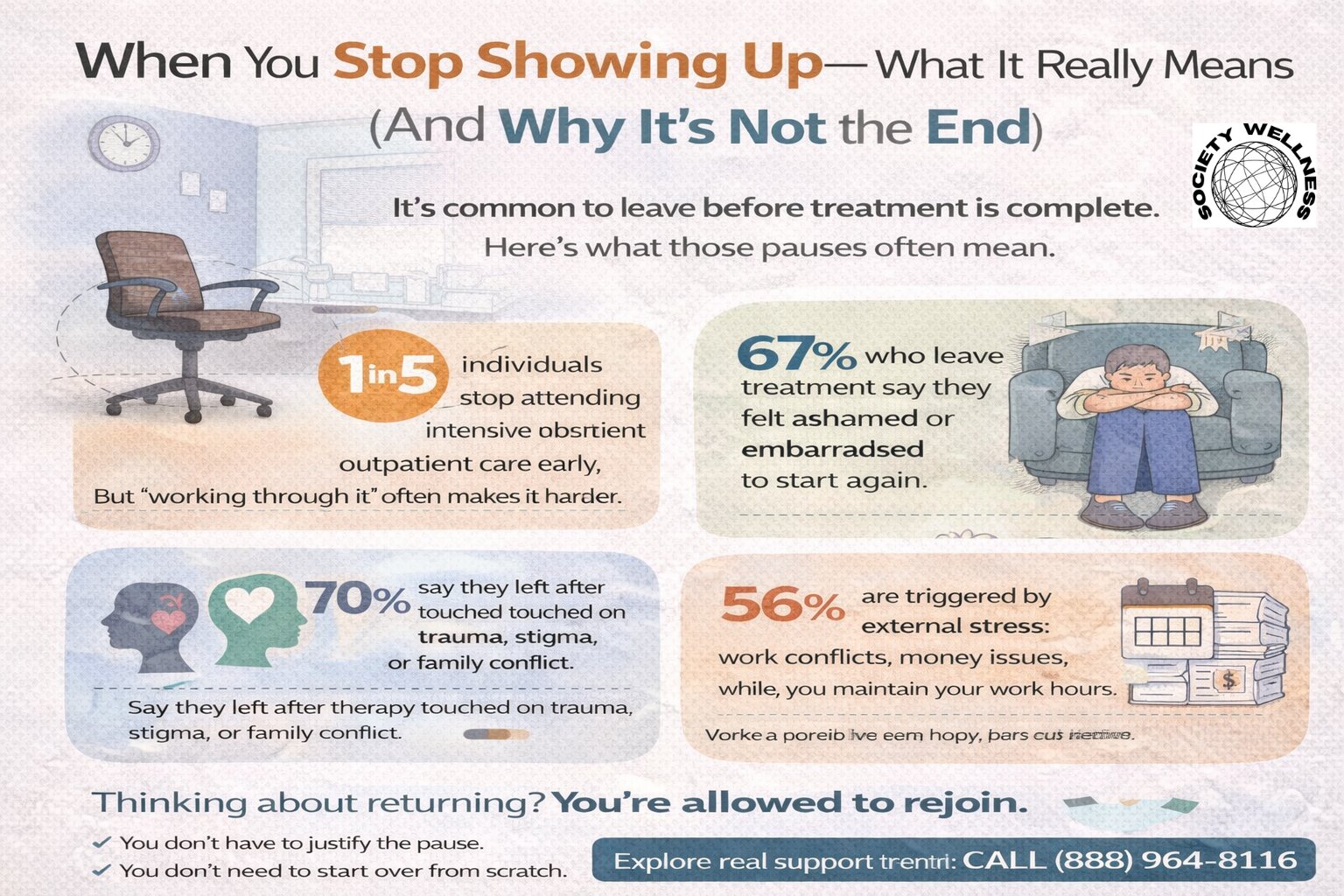
If you stepped away from an intensive outpatient program, I want to speak to you directly — as a clinician who has seen this many times.
Leaving doesn’t automatically mean you weren’t serious.
It doesn’t mean you’re incapable.
And it certainly doesn’t mean you’re not welcome back.
In fact, dropout often tells us something clinically important. Something we can work with.
Let’s talk about what it usually means.
1. Overwhelm Often Hits Right When Treatment Starts Working
One of the biggest misconceptions is that people leave because they “weren’t ready.”
Sometimes that’s true.
But more often, what I see is this:
The work begins to land.
Denial softens.
Numbing strategies get interrupted.
Old grief rises.
Family patterns become clearer.
Shame surfaces.
When you’re in structured, multi-day weekly treatment, there’s less room to hide from yourself. That’s not punishment. It’s part of healing.
But your nervous system doesn’t always interpret growth as safe.
It can interpret it as threat.
When emotions spike, the instinct to escape is powerful. Walking away can be your brain’s attempt to protect you from intensity — not sabotage your recovery.
That distinction matters.
2. Shame Is the Most Common Reason People Ghost
Shame is quiet. It doesn’t usually announce itself.
It sounds like:
- “They’re disappointed in me.”
- “I already messed up.”
- “I’m behind everyone else.”
- “I said too much in group.”
- “They won’t want me back.”
Here’s what’s clinically true:
Shame grows in silence.
When someone misses one session, then two, then three — it often becomes harder to return simply because of imagined judgment.
But treatment teams are trained to expect pauses. We know recovery isn’t linear.
The person who feels the most embarrassed walking back in?
They’re rarely the one we’re frustrated with.
We’re usually just glad they came back.
3. Relapse During Treatment Is Information — Not Expulsion
If you started using again while in treatment, I want to say something clearly:
That is data.
It tells us:
- Where triggers are stronger than coping tools
- Where additional structure may be needed
- Where trauma responses are still active
- Where environmental stressors are overwhelming
It does not erase the insight you gained.
It does not cancel your progress.
And it does not disqualify you from support.
Clinically, relapse during outpatient care often shows us exactly what needs strengthening. It’s not uncommon. It’s not rare. It’s not shocking.
What matters is whether you’re willing to let that information guide the next step.
4. Sometimes Leaving Means the Work Got Personal
There’s a specific moment I’ve seen repeatedly:
A group session hits something deep.
Maybe trauma comes up.
Maybe identity questions feel exposed.
Maybe family pain is discussed openly for the first time.
Maybe grief surfaces unexpectedly.
And the next week — the client doesn’t return.
Not because they didn’t care.
Because something got close to the bone.
When therapy touches the core wound, your instinct may be to retreat. That’s a survival response.
The goal isn’t to shame that response.
The goal is to gently re-approach it with support.
5. External Stress Can Tip the Scale
Not every dropout is psychological.
Sometimes it’s practical.
Work schedules shift.
Childcare falls apart.
Transportation becomes complicated.
Financial stress increases.
Family pressure escalates.
When someone is already emotionally taxed, even small logistical barriers can feel enormous.
If you left because life got chaotic, that doesn’t mean treatment wasn’t valuable. It may mean the structure needed adjustment.
There are often ways to rework schedules, reassess levels of care, or problem-solve barriers.
But that conversation only happens if you come back into contact.
6. Avoidance Can Be a Signal That You Were Close to Breakthrough
Here’s the spicy clinical truth:
The moment people leave is sometimes the moment they were about to shift.
Right before insight.
Right before grief moved.
Right before accountability deepened.
Change can feel destabilizing.
Your identity may have been wrapped around coping strategies for years. Letting go of them — even unhealthy ones — can feel like losing part of yourself.
Stepping away can be your system’s way of slowing down something that feels too big.
That doesn’t mean the breakthrough is gone.
It may simply be paused.
7. What Re-Entry Actually Looks Like
People often imagine returning will involve interrogation:
“Why did you leave?”
“What happened?”
“Are you serious this time?”
In reality, it’s usually much simpler.
Re-entry often starts with:
“Hey… I stopped coming. I think I need support again.”
That’s enough.
From a clinical standpoint, we reassess:
- What changed?
- What didn’t work?
- What felt overwhelming?
- What needs more structure?
- What needs more safety?
The door isn’t locked because you paused.
Treatment is not a one-chance system.
8. Leaving Doesn’t Mean Treatment Failed
It’s important to separate two things:
Leaving treatment
vs.
Treatment being ineffective
Sometimes the timing wasn’t right.
Sometimes the level of care needed adjusting.
Sometimes deeper trauma work needed stabilization first.
Sometimes someone needed to experience the consequences of stepping away to understand the value of structure.
Clinically, recovery is rarely linear.
I have seen people leave structured outpatient care, struggle for months, then return more ready than ever — not because they were forced, but because clarity grew.
Readiness evolves.
9. If You’re Thinking About Coming Back
Notice that thought.
It’s important.
The part of you considering support again is still alive. Still aware. Still hopeful — even if that hope feels small.
You don’t have to return perfectly.
You don’t have to explain everything.
You don’t have to promise forever.
You only have to take the next step.
If you’re exploring structured support again, you can learn more about our intensive outpatient program services and what re-entry can look like at Society Wellness Behavioral Health.
You are allowed to come back.
Frequently Asked Questions
Is it common for people to leave mid-treatment?
Yes. In outpatient behavioral health settings, dropout rates are not unusual. Life stress, emotional overwhelm, relapse, and shame are frequent contributors. Clinically, leaving doesn’t automatically signal lack of motivation. It often signals that something became too intense without enough support.
If I relapsed while in treatment, will I be judged?
No. Relapse is treated as clinical information, not moral failure. Treatment teams are trained to assess triggers, coping gaps, and environmental factors — not to shame clients.
The goal is stabilization and learning, not punishment.
What if I feel embarrassed to return?
Embarrassment is one of the most common barriers to re-entry.
You don’t need a perfect explanation. A simple message saying you’d like to reconnect is enough to restart the conversation.
Most treatment teams are relieved when someone reaches back out.
Does leaving mean I need a higher level of care?
Not necessarily.
Sometimes stepping away suggests more structure might help. Other times, it simply means adjustments are needed within outpatient care.
A reassessment can clarify what level of support fits your current situation.
How do I know if I should return now?
Ask yourself:
- Are my coping skills holding under stress?
- Am I isolating more?
- Have I resumed patterns I wanted to change?
- Do I feel overwhelmed without support?
If the answer to any of these is yes, reconnecting with care may be stabilizing — not dramatic.
What if I’m not sure I’m ready?
You don’t have to be certain.
You only have to be curious enough to ask questions.
Re-entry conversations are exploratory. They don’t lock you into lifelong commitments. They help you understand options.
Can treatment still help if it didn’t “work” the first time?
Yes. Sometimes the first attempt builds awareness. The second attempt builds change. Recovery often unfolds in layers. What didn’t land before may land differently now — especially if life circumstances or internal readiness have shifted.
You are not “the one who couldn’t do it.”
You are someone whose nervous system, circumstances, or shame temporarily outweighed support.
That can change.
If you’re ready to explore what support could look like now, call (888) 964-8116 or visit our intensive outpatient program services to learn more about our Intensive outpatient program services in Massachusetts.